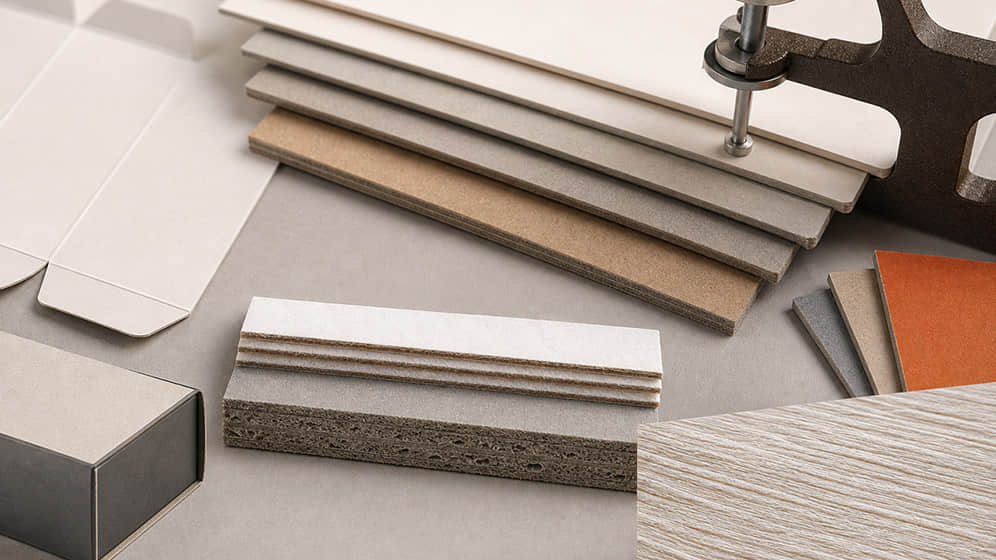
Paper specifications often begin with a familiar number: 250 gsm, 350 gsm, 1,200 gsm and so on.
GSM means grams per square metre. It tells us the mass of a material over a given area, but it does not tell us everything about how that material will perform.
Two sheets with the same GSM can have different thicknesses, densities, surface characteristics and levels of stiffness. They may print differently, fold differently and produce boxes that feel noticeably different in the hand.
For reliable packaging, paper needs to be considered as an engineering material as well as a visual one.
What does GSM actually tell us?
GSM is useful for identifying and comparing paper grades. Generally, a higher GSM indicates that more fibre is present in each square metre of material.
However, GSM does not directly define thickness.
One 350 gsm board may be relatively dense and thin. Another may contain more bulk, making it thicker but not necessarily stronger in every direction.
This difference matters because packaging performance depends on several properties:
thickness;
stiffness;
density;
fibre composition;
moisture content;
coating;
grain direction.
Selecting board solely by GSM can therefore lead to unexpected results.
Thickness influences structure and fit
Thickness is normally measured in microns or millimetres.
It affects the physical dimensions of the finished package, particularly where several layers meet. In a folding carton, board thickness influences crease settings, locking tabs and closure performance. In a rigid box, the thickness of greyboard affects the space between the lid and base.
Small differences can become significant.
For example, if a covering paper is changed to a thicker specialty paper after the structure has been sampled, the lid may become tighter. If an insert material varies in thickness, the product may be difficult to fit or may move inside the box.
Thickness must therefore be included when calculating:
lid-and-base clearance;
folding allowances;
insert openings;
divider slots;
wrapped edges;
multi-layer structures.
The dimensions of packaging cannot be separated from the behaviour of its materials.
Stiffness determines how the board resists bending
Stiffness describes how resistant a sheet is to bending. It has a direct effect on how substantial a carton feels and how well it maintains its shape.
A board may be thick but comparatively soft. Another may be thinner yet provide stronger resistance because of its fibre structure and density.
Stiffness is particularly important for:
The required stiffness depends on the dimensions and structure of the packaging. Increasing GSM is not always the most efficient answer. A structural change—such as adding a folded edge, locking base or internal support—may improve performance without simply adding more material.
Density affects both feel and performance
Density is the relationship between the weight and thickness of the board.
A denser material often feels compact and firm. A bulkier material may feel thicker and more tactile at the same GSM.
Neither is automatically superior.
Dense board may support crisp printing and accurate creasing, while bulkier board may provide a substantial feel with less mass. The best choice depends on the structure, print design and desired customer experience.
For premium packaging, the tactile impression can be as important as the numerical specification. This is why physical material samples are more informative than a GSM value on a quotation.
Grain direction is easy to overlook
Paper is made from fibres that tend to align during manufacturing. This creates a grain direction.
The sheet bends more naturally in one direction and resists bending more strongly in the other. Grain direction can influence:
If a major fold runs in an unsuitable direction, the board may resist the fold or show more visible cracking. This is especially noticeable on thick board, dark printed areas and uncoated papers.
Grain direction also matters in rigid-box production. The covering paper and board can respond differently to changes in humidity. If their directions and tensions are poorly managed, the finished component may curl or warp.
Why do printed folds sometimes crack?
Fold cracking occurs when the surface layer breaks along a crease, revealing lighter fibres beneath. It is particularly visible on dark, heavily printed cartons.
Several factors can contribute:
unsuitable grain direction;
board that is too thick for the crease;
incorrect creasing-channel width;
insufficient crease depth;
dry material;
heavy ink coverage;
surface coating or lamination;
a fold that is too sharp for the board.
The solution is not simply “use better paper”. Creasing tools and production settings must be matched to the material.
Sampling allows the supplier to assess how a selected board behaves before the full quantity is produced.
Moisture changes paper behaviour
Paper absorbs and releases moisture according to the surrounding environment. As its moisture content changes, its dimensions and flexibility may change as well.
This can contribute to:
Materials should be stored in suitable conditions and allowed to acclimatise where necessary. Production sequencing also matters: freshly printed or laminated sheets may require adequate drying or conditioning before they are cut, wrapped or assembled.
Packaging destined for humid environments or long-distance sea transport may require additional consideration.
Surface coatings influence more than appearance
Coated paper normally provides a smoother surface and stronger colour reproduction. Uncoated paper offers a more natural texture but absorbs ink differently.
Lamination, varnish and other coatings can improve resistance to moisture, dirt and abrasion. They can also change:
A coating should be chosen according to the use of the packaging—not simply because it appears on a standard list of finishes.
For example, a matt surface may suit a premium gift box but show friction marks during transport. A more resistant finish or improved packing method may be needed.
Greyboard also varies in quality
Rigid boxes commonly use greyboard as their structural core. Its specification may be expressed by thickness, GSM or both.
Greyboard quality affects:
A smooth covering paper cannot completely hide an uneven core. For boxes with large flat surfaces, a consistent board is essential.
The appropriate thickness should be selected according to the box dimensions, product weight and desired presentation. Making every box from the thickest available board would add cost and weight without necessarily improving the design.
Ask for a performance-based recommendation
Instead of requesting only “350 gsm paper”, describe what the packaging needs to do.
Tell the supplier:
the product dimensions and weight;
whether the box will be stacked;
how it will be transported;
whether it will be exposed to moisture;
how the customer will handle it;
whether the surface has dark printing or demanding finishes;
whether the packaging must be supplied flat.
This gives the production team enough information to recommend a board according to performance rather than habit.
The specification is only the beginning
GSM remains an important part of a paper specification, but it should be considered alongside thickness, stiffness, density, grain direction and surface treatment.
Professional material selection asks a more useful question than “How heavy is this paper?”
It asks: “How will this material behave in this particular box?”
That difference helps prevent cracked folds, weak panels, poor-fitting lids and unnecessary material costs.
Not sure which board is suitable for your packaging? Send us the product size, weight, box style and delivery requirements. We can recommend materials and prepare a structural sample before mass production.