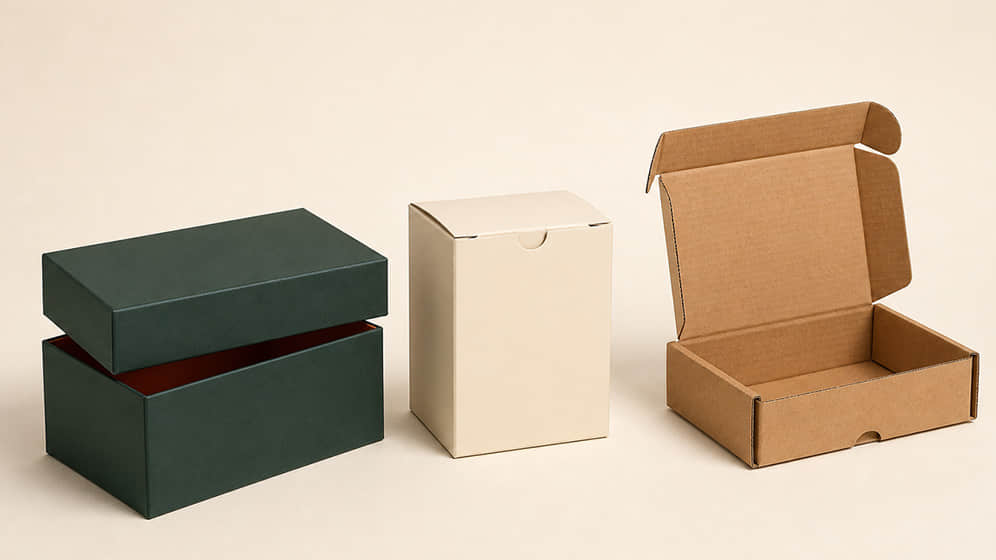
One of the first decisions in a custom packaging project is choosing the box structure. It can also be one of the most confusing.
A rigid gift box may look impressive, a folding carton may offer better production efficiency, and a corrugated mailer may provide stronger protection in transit. None of them is universally “better”. The correct choice depends on what the packaging needs to achieve.
Let us look at the differences in practical terms.
Rigid boxes: premium presentation and a stronger sense of value
Rigid boxes are made from thick paperboard—often greyboard—wrapped with a printed or decorative covering paper. Unlike folding cartons, they are normally delivered in their finished three-dimensional form.
Common rigid-box structures include:
two-piece lid-and-base boxes;
magnetic book-style boxes;
drawer boxes;
shoulder or neck boxes;
hinged presentation boxes.
Their greatest strength is the physical experience. A well-made rigid box feels substantial in the hand, opens in a controlled way and creates a strong sense of occasion.
Rigid boxes are well suited to:
premium gift sets;
mooncakes and seasonal food gifts;
tea and wine;
cosmetics and fragrance;
jewellery and accessories;
corporate gifts;
limited-edition products.
They also provide a good platform for textured papers, foil stamping, embossing, ribbons and custom inserts.
However, rigid boxes require more material, more hand-finishing and more storage space. Because they are usually shipped assembled, their transport volume can be considerably higher than that of flat-packed cartons.
Choose a rigid box when presentation and perceived value justify the additional production and logistics cost.
Folding cartons: efficient, versatile and retail-friendly
Folding cartons are produced from paperboard that is printed, cut, creased and supplied flat. They are assembled when the product is packed.
Common examples include:
Folding cartons are lighter and generally more economical than rigid boxes. Their flat-packed format saves storage and shipping space, while modern printing and finishing techniques still allow them to achieve a polished appearance.
Folding cartons work particularly well for:
The board grade and bottom structure must be selected carefully. A standard tuck-end carton may be suitable for a light product, while a heavier item may need a reinforced or automatic-lock base.
Folding cartons are a sensible choice when production efficiency, retail presentation and space-saving are important.
Corrugated mailers: protection for delivery and e-commerce
Corrugated packaging contains a fluted paper layer between liner sheets. This construction gives the box greater resistance to impact and compression without requiring a very heavy solid board.
Corrugated mailers are commonly used for:
Different flute profiles provide different balances of strength and appearance. Finer flutes create a smoother surface for printing, while larger flutes generally provide greater cushioning and stacking strength.
A printed corrugated mailer can still deliver a strong brand experience. Interior printing, well-designed opening details and a paper-based insert can turn a practical shipping box into attractive consumer packaging.
The main consideration is appearance. Even fine-flute corrugated board has a different character from a rigid presentation box or smooth folding carton. It tends to feel practical, modern and delivery-focused rather than traditionally luxurious.
A simple comparison
Consideration | Rigid box | Folding carton | Corrugated mailer |
Presentation | Premium and substantial | Clean and versatile | Practical and contemporary |
Protection | Good, especially with an insert | Moderate | Strong for transport |
Unit cost | Usually highest | Usually lowest | Moderate |
Storage space | Requires more space | Supplied flat | Often supplied flat |
Assembly | Often ready-made | Requires folding | Usually quick to assemble |
Shipping efficiency | Lower | High | High |
Best use | Gifts and premium products | Retail and food packaging | E-commerce and delivery |
These are general comparisons. The final result depends on the board grade, dimensions, insert, surface finish and production quantity.
Consider the complete packaging journey
The decision should not be based only on how the box looks in a design rendering. Ask what happens at every stage:
How will the empty boxes be delivered and stored?
Who will assemble and pack them?
Does the product need an insert?
Will the box be displayed in a shop or sent by courier?
Will several boxes be stacked inside an export carton?
What should the customer feel when opening it?
Is the packaging expected to be reused?
For example, a rigid box may create the strongest first impression but require more warehouse space. A folding carton may reduce cost and transport volume but need additional protection for delivery. A corrugated mailer may survive courier handling but look less formal in a luxury retail environment.
Hybrid structures can solve competing requirements
Sometimes one structure cannot meet every requirement.
A premium rigid box can be protected by a separate corrugated shipping carton. A folding carton can use a paper insert to improve product security. A corrugated mailer can carry a printed sleeve to create a more refined retail appearance.
The best packaging is often a carefully balanced system rather than a single box considered in isolation.
Choose according to priorities—not assumptions
Choose a rigid box when the opening experience and perceived value are central to the product.
Choose a folding carton when efficiency, retail presentation and flat storage are the priorities.
Choose a corrugated mailer when protection during delivery matters most.
If you are still unsure, provide your supplier with the product dimensions, weight, sales channel, quantity, target budget and reference images. A structural recommendation can then be based on real production and transport requirements rather than appearance alone.
Planning a new packaging project? Tell us what the box needs to hold, how it will be sold and where it needs to travel. We will help you compare suitable structures before sampling begins.